I looked through a number of definitions of culture in journals, blog posts by well-regarded institutions, but the one that stood out to me was the highest upvoted (7 upvotes) response to a similar question on the /Anthropology Subreddit by the username denidzo 12 years ago who wrote, ‘Culture is the learned, shared, understanding, of what everything means and how to behave.’ The user’s answer is succinct and says a lot through what it covers and what it does not cover.
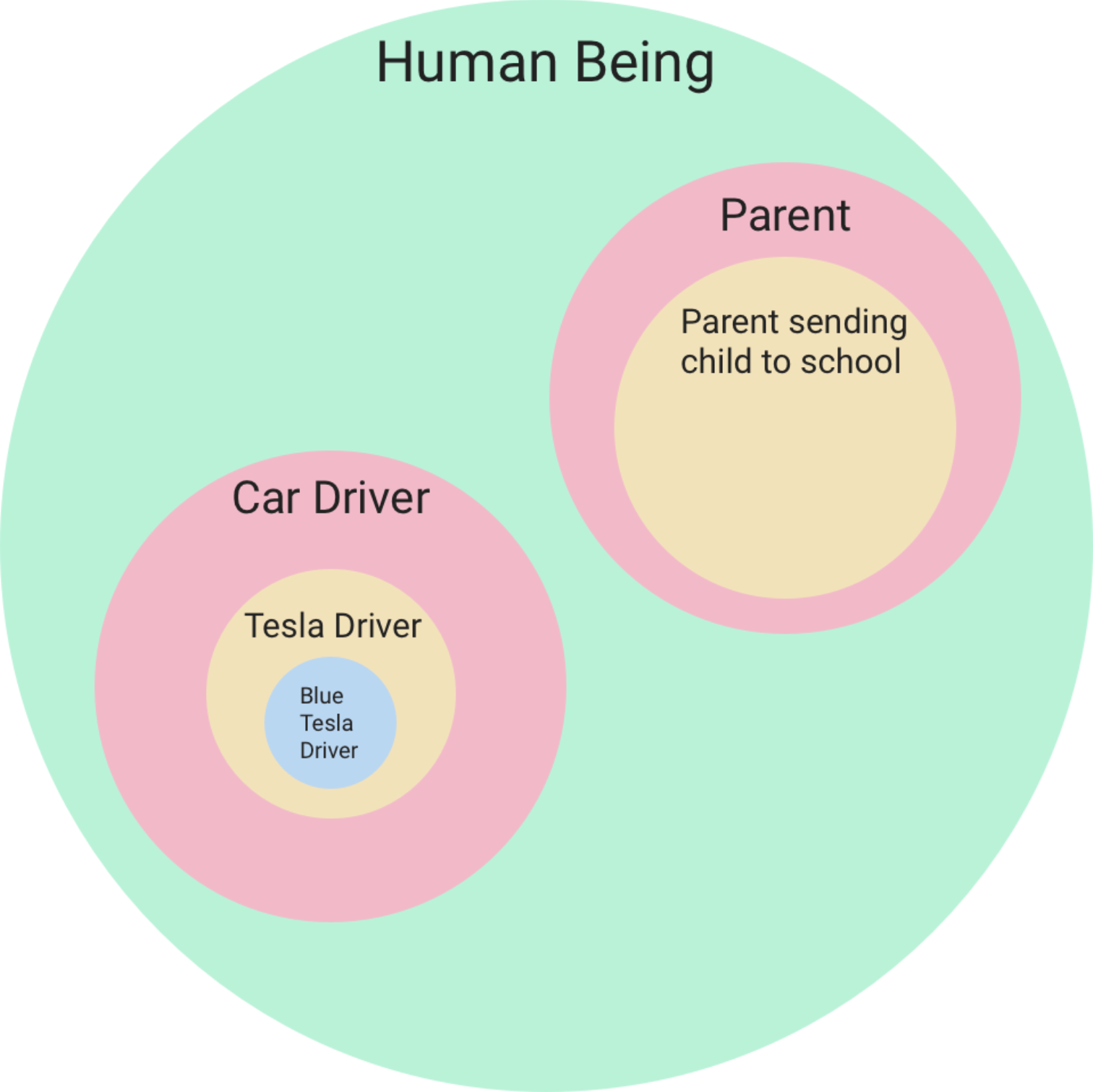
One of the items it does not cover is a specific group of people or beings, there-in not putting people into specific groups. This is important because we as humans exist and identify both perceived and unperceived within many different cultures at any one point in time. An example is when I am driving my daughter to school and a car passes going the other direction, while on the other side of the road there is a mother waiting with her daughter for the school bus on their driveway. I am simultaneously a human, who like the driver of the other car drives a blue Tesla Model 3 and a parent who is dropping their child off at school. The big question is, what makes it a cultural norm that the driver of the other blue Tesla and I wave at each other immediately when I don’t even consider waving at the woman waiting for the bus with her child?
I’ve never met these people and I see the woman and her daughter at the bus stop every day. Is the sub-group of the sub-group of people, the special few who have the same make, model, and color of that specific vehicle so special and unique that we have to acknowledge it to each other in the fleeting instant we have? It’s not even a Tesla thing, because before the Tesla, when I drove a red Mini-Cooper I was suddenly and firmly in the Mini-Cooper group and the waves were flying back and forth unlike any other car I’ve driven.
I exist in many cultures within that instant, but the culture I choose to identify as is not the parent of my spawn, but as the driver of the same vehicle as the other person I’m passing. It’s a perfect encapsulation of that definition above though, because waving to someone who has the same car as you is a learned behavior. Imagine how exciting it was the first time someone who drove the same car you did waved to you on the road, so exciting that you internally, and subconsciously vow that in the future, whenever you recognize that someone drives the same car as you, you’ll wave to them. Now, as you get older and see more cars that are the same as your car, your enthusiasm wanes. Your waves may become nods or some sort of hand up, palm resting on the steering wheel salute, but this too is a learned behavior, since you’re emulating the older, less excited demographic of car wavers.
People exist as part of multiple cultures everywhere, but here we’re talking about bowling alleys and as the great John Goodman put it, “This isn’t ‘nam, this is bowling, there are rules.” (Coen, 1998)
Movies are an obvious cultural bond maker, more so because the shared understanding, knowledge, and learnings allow people who may otherwise exist in completely different cultures bridge those gaps and unite in their shared understanding of having watched the same movie. Unlike other sports movies that feature an element of the sport/activity like the Happy Gilmore golf swing, the two major bowling movies, ‘The Big Lebowski’ and ‘Kingpin’ don’t have any major element of the act of bowling that makes it into popular culture. The closest is John Goodman freaking out about Smokey being over the line or John Turturro licking the ball, both of which are fantastic elements of the movie, but neither cross into the general iconic movement of the sport that when emulated gardner laughs and comprehension.
What they do have is iconic characters that play on the vibe of bowling contrasted with the competitive nature of the people engaging in the activity. There’s variation of course, but observing the mean, the better the bowler, the more concerned they are over their score and the more competitive they are with themselves and with others. This variation of intensity and level of caring is the biggest cultural trope of both movies and of bowling in real life. Rarely in sports or activities do you have the possibility to get a very good amateur or even a professional bowler rolling next to a beginner throwing the ball between their legs and every level of skill, competency and level of caring in between.
When I bowled at Broadway Bowl, I didn’t ask the manager working on the schedule why he put me in the farthest lane he could from the families bowling, when I was bowling alone, but he said that he was doing it for me, like he was doing me a favor. My assumption was that he assumed that I was a decent bowler, albeit one that rented his own shoes and ball, and since I was bowling alone, I wanted to be as far away from other people, including families, as possible.
I visited Broadway Bowl on a quiet Saturday, midday, just after the alley opened and there were three lanes already in use, with nearly all of them filled by the time I left an hour later. At Bayside Bowl, I had to wait over an hour the Monday after the Superbowl for a lane to open up, nevertheless, there’s a general perception backed by data that bowling is a dormant sport. Since bowling was popularized in the 1930s, it’s difficult to quantify the changes in the industry. The easiest way to do it is examining professional bowling. In their piece, The Rise and Fall of Professional Bowling, Zachary Crockett of Priceonomics wrote that in 1964 professional bowler ‘Don Carter was the first athlete in any sport to receive a $1 million endorsement deal…At the time, the offer was 200x what professional golfer Arnold Palmer got from his endorsement with Wilson, and 100x what football star Joe Namath got with Schick razor.’ (Crockett, 2014) Don Carter was already making $100,000 per year before that deal was signed. Later in the article Crockett posted a list of the PBA’s money list 50 years later. The top earner made $248,317.
Times change and sports go in and out of vogue, but the wane of bowling is not surprising, given the broader cultural shift toward individual isolation. In his article, ‘Why Americans Suddenly Stopped Hanging Out,’ in The Atlantic, Derek Thompson wrote, ‘The first explanation is so obvious that it scarcely needs mentioning…Americans are spending less time with other people because they’re spending more time with their screens—televisions and phones.’ (Thompson, 2024) While smartphones may have expedited the trend, in the case of hanging out in bowling alleys, hanging out in general has been in decline since the early 1970’s. Derek Thompson spent a lot of time looking into the American Time Use Survey and came up with three additional explanations including that, ‘Many Americans have traded pets for people time,’ (Thompson, 2024) people have become much busier, and Putnam’s theory in Bowling Alone: The Collapse and Revival of American Community that, ‘The rise of aloneness is part of the erosion of America’s social infrastructure.’ (Thompson, 2024)
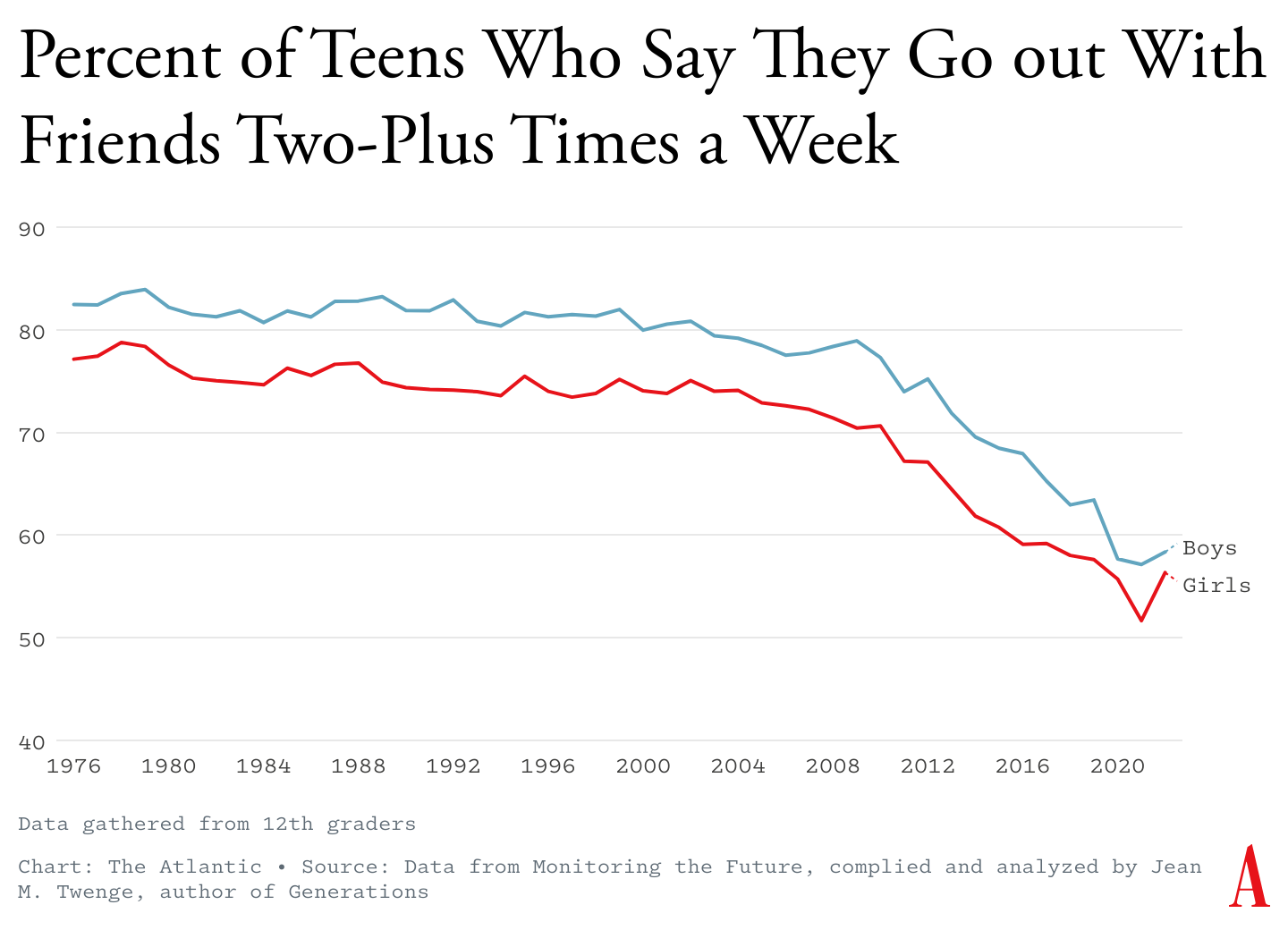 (Thompson, 2024)
This attrition of interacting with other human beings in places of congregation is our culture in 2024 and it’s evident within the busy bowling alleys I visited. With the exception of the few people I observed getting coached on their bowling technique, I did not observe one person who went to the bowling alley to meet people outside of the individuals they bowled with in their lane. Because of this, I cannot recall any interaction between people in different groups. The culture of bowling morphed from being a social activity during the boom of socialization from the 1930’s to the 1970’s to a siloed activity within preset small social groups in present day.
*My major caveat into present day bowling social norms is that I have not as of yet observed a bowling league or the level of human interaction that takes place within this orchestrated group activity, ironically because I too don’t have the free time or capability to observe such activities when they are happening.
I would be remiss if I didn’t mention the minor cultural norms associated with bowling, as there are with any activity. It’s frowned upon and disruptive to bowl at the same time as another bowler in the next lane, or possibly even two lanes away, since the reverberation of the ball hitting the lane can affect the other person’s shot. Although I haven’t seen it or anything close to it in person, my assumption is that if someone is on the track for a perfect 300 score, you don’t chat them up if you’re bowling with or alongside them. As that guy in the movie Swingers said, ‘It’s kind of like not talking to your pitcher in the middle of a no-hitter.’ (Liman, 1996)
Bowling gear is an obvious cultural signifier and bond-maker in the shared activity. Wearing bowling shoes is an obvious requirement. Although most bowling balls are rented, once someone chooses a bowling ball and places it in the chute basket, most people see it as their ball, not a ball to share. Bowling shirts have become a trope too, though a group of people committing to wearing bowling shirts even if they are not the same design is an acknowledgment that they’re in on the joke, and although I haven’t seen it and it’s supposition, they’re perhaps more willing to socialize with others.
Again though, this interaction between groups is something I did not observe when I went to the bowling alleys. This is despite the two bowling alleys I visited seemingly by their architectural design encouraging and having space for people to interact outside of the lanes with tables and chairs apart from the lanes, bars, live-music areas, eating areas, and in one case a rooftop bar, and an enormous table tennis area. All of these areas were empty. The lanes were full though, since people were just there to bowl within their own groups. They exist in many different cultures within their bowling lane as a part of these groups, but the overarching bowling culture of interaction between large masses of people has been replaced with the planned group or individual isolation within the confines of a bowling lane.
From an ethnographic perspective, the individual isolation of people within these groups is both interesting, alarming, and frustrating. The way bowling alleys are laid out and with the amount of noise they have, unless I’m positioned at the edge of a lane or within a lane, it’s difficult to observe most people up close or eavesdrop on conversations. Individual’s motions and reactions are important, but their conversations within their small groups may provide important information into critical differences in the limited social interactions of bowling today vs the gathering alleys of yesteryear.
Cameron, John, et al. The Big Lebowski. PolyGram Filmed Entertainment Presents, 1998.
Crockett, Zachary. “The Rise and Fall of Professional Bowling.” Priceonomics, 20 Mar. 2022, priceonomics.com/the-rise-and-fall-of-professional-bowling/.
Denidzo.” Defining Culture.” Reddit, 17 Dec. 2011, https://www.reddit.com/r/Anthropology/comments/ngrr8/defining_culture/
Farrelly, Peter and Bobby Farrelly, directors. Kingpin. Metro-Goldwyn-Mayer, 1996.
Liman, Doug, director. Swingers (1996). Miramax, 1996.
Thompson, Derek. “Why Americans Suddenly Stopped Hanging Out.” The Atlantic, Atlantic Media Company, 15 Feb. 2024, www.theatlantic.com/ideas/archive/2024/02/america-decline-hanging-out/677451/.